Showing posts with label HMH. Show all posts

Monday, April 8, 2024

It Doesn't Have to Be Awkward: Dealing with Relationships, Consent, and Other Hard-to-Talk-About Stuff, written by Drew Pinsky and Paulina Pinsky, reviewed by Bethany Bratney

Summary:  TV doctor, Dr. Drew Pinsky, and his daughter, Paulina, team up in this accessible, well-paced book about relationships. The entire book is framed through a concept introduced in the first chapter - that all relationships, whether romantic, platonic, friendships, family relationships, etc. should be governed by the rule of TCB - trust, compassion, boundaries. The topics in the book range widely, highlighting chapters on self-identity, friendships, attraction, bullies, crushes, sex, substance abuse, assault and more, but always return to the TCB tagline, reminding readers that any of these situations will improve and benefit from building trust, harnessing compassion for yourself and others, and establishing clear and consistent boundaries.The Pinskys offer many anecdotes, both from their own lives and from teens they have spoken to, to illustrate their points, and there are frequent callout boxes with quizzes, important messages, and top three takeaways for each chapter. The book contains copious back matter, including many additional resources and support offerings.

Straight Talk for Librarians:  This book is an important addition to the ever-challenging human growth and development section of the library. The majority of the text is focused on taking care of oneself, communicating clearly and effectively, and making informed and important decisions within relationships. Though the text does address potentially controversial topics like sex and masturbation, these are discussed without specifics of the acts themselves, and always tied to important emotional factors, like consent, self-awareness and understanding, and breaking through common misconceptions and stereotypes. That being said, the authors (without details) encourage masturbation as a self-understanding exercise, and suggest that sex does not only have to happen in committed relationships as long as TCB is in operation, so more conservative parents or communities may struggle with such concepts. Many parents would hand this title to middle school students, but it is probably better housed in a high school collection for general use. Overwhelmingly, though the topics of this book could indeed feel awkward, the focus is on healthy relationships and interactions with a focus on understanding and communicating emotions, which would make it a useful text related to human health or biology curriculum, and a valuable addition to a collection for teens who are experiencing or surrounded by these concepts for the first time.
 

Thursday, April 4, 2024

The Little Mouse, the Red Ripe Strawberry & the Big Hungry Bear El ratoncito, la fresa roja y madura y el gran oso hambriento, written by by Audrey Wood and Don Wood, reviewed by Klaudia Janek

Summary:  This is an English and Spanish bilingual book.  The English text is in black font below the Spanish text which is in red font.  This is a board book that follows a mouse as he finds a huge, red strawberry.  The narrator is warning the mouse that the bear will come to steal the strawberry.  Mouse tries to hid it and disguise it.  Finally, he splits it with the narrator.  The illustrations have beautiful muted forest colors and the expressions on the mouse’s face will have young readers laughing.

Straight Talk for Librarians:  The language development with a familiar story will be beneficial for students learning either Spanish or English.  Perfect for any bilingual elementary library or classroom.  Schools with mostly English speakers will benefit from this book if they offer Spanish classes.  I am putting this book in my high school library because we have a lot of new Spanish language learners.  This is perfect for first-year students learning Spanish.  They might already be familiar with these characters and will appreciate both languages on the page.  Students will learn new vocabulary and practice their reading comprehension.
 

Wednesday, April 3, 2024

Clarinet & Trumpet, written by Melanie Ellsworth, illustrated by John Herzog , reviewed by Klaudia Janek

Summary:  Clarinet and Trumpet “were friends from the first note.”  The author explains that the trumpet is a brass instrument and the clarinet is a bit “long-winded” alluding to being a wind instrument. They supported and helped each other out all the time. One day the double-reed Oboe walked in and a new friendship started to form between the two woodwinds. Trumpet became jealous and even went so far as to compose a fanfare for his old friend. In a twist, Trombone “slid” in with his new friend Trumpet.  In a hilarious scene, Trombone emptied his spit valve right on Oboe.  Any musician will know how gross this is.  Flute sided with the woodwinds.  French Horn joined the brass group.  Bassoon joined team woodwinds and all of a sudden Saxophone swings in.  Saxophone has both a reed and is made out of brass.  He didn’t fit either side.  But everyone liked him because of his mellow, smooth sound.  They realized that they could all make great music together and should be friends.
Straight Talk for Librarians:  This book is a perfect introduction to some music vocabulary and band instruments.  The book can shake and rattle like a maraca, which young readers will LOVE!  It’s a great lesson on how the instruments are grouped together in a band or orchestra, specifically brass and woodwinds.  It has vocabulary like crescendo and flat, which any music teacher will appreciate.  It makes for a great read-aloud and could be done with different voices.  This would make for a great school librarian and band teacher collaboration.  The band teacher could display all the instruments presented in the book.  I do think some of the vocabulary needs to be defined.  A music teacher could demonstrate the difference between a flat and a sharp note.  Some settings in the illustrations include a stage and a practice room.  The emotions conveyed by the instruments are cute and funny.  The illustrator did a great job with that.  A perfect choice for any elementary school library and music classroom.  It might not be the best choice for any sort of sustained silent reading because the book is loud :)  But that is what makes it even more fun.  My 9-year-old reader summarized the story as “they hated each other and then they liked each other.” 

Friday, March 29, 2024

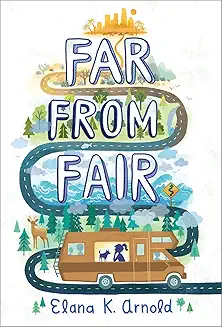
Far from Fair, written by Elana K. Arnold, reviewed by Klaudia Janek

Summary:  Far from Fair is a perfect title for this book as we follow the events of Odette’s life.  Her father is laid off from his job.  They are selling their house and most of their things in California and preparing to live in a camper as they make their way up to Oregon.  They are going to Oregon because Odette’s grandma has cancer and is very sick.  Odette’s brother is autistic and she feels that it’s unfair that her parents have different standards for both of them.  Finally, Odette has to leave her friends behind and start over.  Oh, and to top it all off, mom and dad are having marriage problems. She is not happy and lets it be known throughout the story.  When they get to the island that Grandma Sissy lives on, Odette meets a boy, she gets to help run the bakery and the pace of life is a bit slower.  The underlying message of this story is that life is not fair, but you have to make the best with what you have to work with.

Straight Talk for Librarians:  I thought the cover of this book was beautiful and really went with the camper life theme.  I think most readers would sympathize with Odette.  She is having a lot of hardships in life and a lot of changes are coming too quick.  This story explored friendships, family dynamics and grief.  This book is targeted to ages 9-13 (grades 3-7) and I certainly believe that grief has a place in fiction and it needs to be explored.  However, I think the author went too far with diving into Oregon’s Death with Dignity law and sort of compared euthanasia to putting down a pet.  It got even more political when Odette’s brother had an exotic animal as a pet (ferret) which is illegal in California, but legal in Oregon.  It’s these political state laws, which are complex, that really hinted at ideologies that might not yet be appropriate for the age group targeted.  Depending on religious leanings, parents might be completely opposed to the POV presented in this book.  I think the intended age group is too young for the level of detail of grandma taking the drug cocktail to die.  There is also the possibility that younger readers are not well-schooled in individual state rights and might not fully understand what is going on between California and Oregon.  Only one of the professional reviews mentions this and others are ambiguous about the details.