Summary: Set in 1980, the story follows Katy and her best friend, Joel, as they investigate a mysterious and troubling problem in their hometown, Lorane Creek has become contaminated. The water smells terrible, looks strange, and is making people sick. Joel can't stop getting sick, Katy's eyes burn, and the toxic backup is even making her grandmother's home unsafe. As Katy and Joel document the strangeness and discover a sinister man deliberately dumping pollutants into the water, they realize the problem mirrors the bullying they face at school. The bullies, both the man polluting the creek and their classmates, operate because they believe they can get away with their actions. As the contamination threatens to ruin the creek and the community, Katy, Joel, and their neighbors must find the courage to stand up to these bullies before it's too late. Woven throughout are excerpts from a school assignment Katy is working on that describe a future readers will recognize as contemporary, drawing connections between past, present, and future. The author layers multiple important themes: environmental justice, classism, corruption, sexism, and upstanding, into a narrative that feels both nostalgic and empowering.
Friday, October 16, 2026
It Came from the Creek written by Amy Sarig King and reviewed by Klaudia Janek
Summary: Set in 1980, the story follows Katy and her best friend, Joel, as they investigate a mysterious and troubling problem in their hometown, Lorane Creek has become contaminated. The water smells terrible, looks strange, and is making people sick. Joel can't stop getting sick, Katy's eyes burn, and the toxic backup is even making her grandmother's home unsafe. As Katy and Joel document the strangeness and discover a sinister man deliberately dumping pollutants into the water, they realize the problem mirrors the bullying they face at school. The bullies, both the man polluting the creek and their classmates, operate because they believe they can get away with their actions. As the contamination threatens to ruin the creek and the community, Katy, Joel, and their neighbors must find the courage to stand up to these bullies before it's too late. Woven throughout are excerpts from a school assignment Katy is working on that describe a future readers will recognize as contemporary, drawing connections between past, present, and future. The author layers multiple important themes: environmental justice, classism, corruption, sexism, and upstanding, into a narrative that feels both nostalgic and empowering.
The Oregon Trail #1: The Race to Chimney Rock written by Jesse Wiley and reviewed by Debra Gantz
Summary: This Choose Your Own Adventure in the Oregon Trail series took me right back to the early 90's and playing this game with students in public schools where I was a substitute teacher. (The game had everything and I wanted to know how this book series could capture that excitement, dread, wonder, and risk taking.) Jesse Wiley must have played the game, as well as this book has it all! Backmatter guides you to how to problem solve issues that affected Westward settlers. (A foreword reminds readers to read the backmatter before making their first decision.) There are short sections/chapters of only a few pages and then you face a choice. Choose right and your journey continues. Choose wrong and you may die or be lost or be without supplies including that wagon that is your chance for a better future. I chose well for a bit, but then there was an impossible choice that I did not like at all and I did die. I went back to where I had chosen wrong and made a new choice. This time I finished the journey and ended at Chimney Rock. I did go back and read more with different choices to see what would have happened. In short, this is a fun book and I think my students will like it.
The Oregon Trail #7: Gold Rush! written by Jesse Wiley and reviewed by Debra Gantz
The Oregon Trail #8: The Oregon Trail: Calamity in the Cold written by Jesse Wiley and reviewed by Debra Gantz
Summary: Moving from Florida to Oregon is no easy feat in 1845. Unusual weather also makes the trail more difficult. Many hazards await. Will teaming up with a Cherokee family you meet along the way increase your chance of success? I made more mistakes in this book than in The Race to Chimney Rock. I realize that the game I used to play with students early in my career allowed me not to walk away. I saw the words The End, returned to my choice and continued the story. When I finally reached Oregon City, I felt that same rush. This book did not have to be read specifically before or after the last. It stands alone with its own challenges. I look forward to sharing this with students next year.
Monday, March 23, 2026
Freedom Swimmer written by Wai Chim, reviewed by Bethany Bratney
Summary: Ming lives in a coastal village in China during the Cultural Revolution in the 1960s. He is an orphan after watching his mother die of hunger during the Great Leap Forward. His father had drowned years before after trying to swim to freedom in Hong Kong (a “freedom swimmer”). As part of the Communist re-education program, a number of city boys are sent to villages to learn the work and share their knowledge, including Li, who Ming quickly befriends. The two boys have little in common, but bond over evening swims and their shared labor in the fields. As life becomes increasingly difficult, and suspicions about Li’s family at home arise, the boys begin to ponder a better life elsewhere.
Crow Mountain written by Lucy Inglis, reviewed by Bethany Bratney
Summary: Hope is visiting Montana while her mother does research on a ranch with a particularly undisturbed ecosystem. While there, Hope meets Cal Crow, ranch hand and son of the owner. Despite an immediate attraction, they maintain a friendly relationship while Cal takes Hope under his wing and teaches her about ranch life. Hope finds an old, abandoned journal at the ranch and begins reading it, which kicks off the second narrative of another British girl in Montana, Emily, who is rescued in a time of crisis by a horse-trader named Nate. The story moves back and forth between Hope and Emily as each explores her new environment, finds herself in dark and dangerous moments, and is forced to engage in a partnership with a local liaison. When Hope and Cal are stranded in similar fashion to Emily and Nate, the parallels to the stories become increasingly strong and Hope begins to make connections between Emily’s life in the past, and the Crow family in the present.
Monday, February 9, 2026
A Beautiful and Terrible Murder written by Claire M. Andrews, reviewed by Klaudia Janek
Monday, September 22, 2025
Anya #1: Anya and the Dragon written by Sofiya Pasternack and reviewed by Rebecca Lowe
Our Castle by the Sea written by Lucy Strange and reviewed by Rebecca Lowe
Summary: 11-year-old Petra, called Pet, is growing up living in a lighthouse on the coasts of England at the start of World War II and must gather her courage to survive the challenges ahead. The daughter of a German immigrant mother, Petra must deal with changing attitudes from her neighbors due to her heritage, her mother being sent away as an "enemy alien," a tragedy in her family related to the war, a saboteur in her small village, the threat of being evacuated from her beloved home with or without her sister, and the dangers of enemy aircraft.
Tuesday, March 25, 2025
Rebellion 1776 written by Laurie Halse Anderson and reviewed by Klaudia Janek
Summary: From bestselling author Laurie Halse Anderson comes a engaging middle-grade historical fiction novel, "Rebellion 1776." Set during the chaotic spring of 1776, the story follows thirteen-year-old Elsbeth Culpepper, who finds herself alone and struggling after her father goes missing amidst the Siege of Boston. As the city grapples with the tumult of the Revolutionary War and the devastating smallpox epidemic, Elsbeth must navigate her new reality while seeking employment to avoid an orphanage. Having survived smallpox as a child, Elsbeth takes a job caring for a wealthy family awaiting inoculation. The narrative beautifully intertwines her personal challenges with the historical context of the time, showcasing the public’s fear of inoculation and the fight for survival against an invisible enemy. Elsbeth’s resourcefulness and humor shine through as she develops relationships with those around her, including the conflicted Hannah Sparhawk. Anderson’s attention to detail in depicting the era and the struggles faced by her characters offers readers a poignant look at resilience and courage during a time of upheaval. "Rebellion 1776" is a powerful story that connects historical events with the personal journeys of young individuals.
Monday, March 10, 2025
Botticelli's Apprentice written and illustrated by Ursula Murray Husted, reviewed by Klaudia Janek
Tuesday, January 7, 2025
The First State of Being written by Erin Entrada Kelly, reviewed by Klaudia Janek
Monday, November 4, 2024
Into the Dim #2: Sparks of Light written by Janet Taylor, reviewed by Klaudia Janek
Project 1065 written by Alan Gratz, reviewed by Klaudia Janek
Wednesday, July 31, 2024
Sixteen Scandals, written by Sophie Jordan, reviewed by Klaudia Janek
Thursday, March 28, 2024
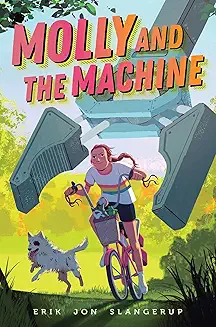
Molly and the Machine, written by Erik Jon Slangerup, reviewed by Klaudia Janek
Straight Talk for Librarians: This book was so fun to read! It’s hard to know how to classify it. It is realistic fiction, but it can also be considered historical fiction as it is set in the 1980s. It’s also got a bit of a science fiction twist, along with some action and mystery. Molly is the main female character who defies stereotypes as she likes to tinker and fix things. Most of the rest of the characters are boys, so I do think it will appeal to a wide range of readers. This book could be integrated into a STEM program because of all the inventing and tinkering. Those readers who grew up in the 80’s (!) will find lots of nostalgia and remember a time when we were not all connected to our phones at all hours of the day. The setting is southern-ish Ohio, so that local connection is fun. I think the giant robot that acquires a mind of its own is relevant to our AI conversations in society and the implications it might have. If you happen to be in an IB school - the Learner Profile attributes of being a risk-taker and a thinker stand out about Molly. It might also be a good recommendation to math and science teachers so they can push some science-related fiction. It’s a great pick for any middle grade school library and book 2 is already out. If you happen to be a school librarian in Michigan and are going to be at the MASL conference - READ THIS BOOK! So you can be prepared for our Author Breakfast event ;)
Friday, May 19, 2023
The Parker Inheritance, written by Varian Johnson, reviewed by Klaudia Janek
Monday, November 21, 2022
I Survived the Hindenburg Disaster, 1937: I Survived #13, written by Lauren Tarshis, reviewed by Amanda Davies
Summary: Hugo and his family are passengers on the famous Hindenburg Zeppelin, traveling from Germany to the United States to get medical help for his sister. While aboard, Hugo learns that the politics of the day weren't left on the ground; Nazis have joined them on the flight, looking for a spy who has stolen important information about secret Nazis living in the United States. Hugo will have to decide how brave he is as the action involves more than just the impending crash.
Straight Talk for Librarians: This is a quick piece of historical fiction that acurately retells the story of the Hindenburg from the perspective of a young person. For students who love historical fiction and want something without any fluff, this is just the thing. Tarshis also provides historical notes and answers questions at the end.
Prairie Lotus, written by Linda Sue Park, reviewed by Amanda Davies
Summary: Hanna and her father have been on the road for years, looking for a place to settle down in the 1880s. Since her mother died, they haven't been able to stay in one place. They continually face anger and discrimination because Hanna is half Chinese. When they settle in LaForge in the Dakota territory, the situation is no different but the two are determined to stick it out to see if they can overcome the threats and racism. Hanna's drive to go to school causes additional tensions in the community, which eventually come to a head amidst stories of survival on the prairie.
Straight Talk for Librarians: This beautiful and stinging book belongs in every school library, K-12. Hanna's story evokes many school librarian's favorite childhood books, Little House on the Prairie. Except here, the realities of what it means to be different extend far beyond the differences between Laura and Nelly. And unlike the blind eye (or worse) that Ingalls Wilder turned to the experiences of Native Americans and immigrants of color, Park embraces these stories and fleshes them out in fully formed historical detail.
Thursday, November 17, 2022
Journey of Little Charlie, written by Christopher Paul Curtis, reviewed by Amanda Davies
Summary: Charlie feels lost. In South Carolina in 1858. His father has passed away and Charlie doesn't know what to do. His father owed money to a powerful overseer, Cap'n Buck, who wants Charlie to pay the debt by hunting down men that he claims stole from him. But Charlie soon discovers that Cap'n Buck is lying; he's actually searching for people who were enslaved and escaped. Charlie, who is White, has to decide whether to entrap the runaways or risk angering Cap'n Buck. Charlie travels North, facing difficult obstacles, none more complex than figuring out what the right thing to do is. Straight Talk for Librarians: The lyric writing, dialect, and constant action of the story make it a fast-paced and engaging read. On its own, it seems strange to tell the story of the impact of enslavement on White people. Paired with Curtis' novels Elijah of Buxton and The Madman of Piney Woods (all part of the Buxton Chronicles), however, this book provides insight into the ways that enslavement impacted all aspects of society. Curtis uses the offensive term "darkie," although it is accurate for the setting.