Monday, March 23, 2026
Recipe for Disaster written by Aimee Lucido, reviewed by Klaudia Janek
Thursday, March 19, 2026
Goddesses of the Underworld #1: Hekate - The Witch written by Nikita Gill, reviewed by Klaudia Janek
Summary: Hekate is a novel in verse retelling of the Greek goddess Hekate's journey from a child of war to a powerful witch goddess. Born amidst the conflict between the Titans and Olympians, Hekate is forced into the Underworld for safety. Raised by Styx, Pallas, Charon and Hades, she navigates the macabre realm, seeking her purpose. As she uncovers her powers, Hekate realizes her unique ability to end the immortal conflict. The book is written in evocative verse, exploring themes of empowerment, identity, and resilience. Through Hekate’s eyes, readers experience the beauty and brutality of the ancient world, while she discovers her strength and destiny. Readers will also see Hekate falling in love with Thanatos, which was a favorite part of the story for me.
Wednesday, November 6, 2024
The Crossover #0.5: Rebound written by Kwame Alexander, reviewed by Klaudia Janek
Tuesday, September 24, 2024
The Seventh Raven written by David Elliott, reviewed by Bethany Bratney
Summary: Based on the Grimm’s Fairy Tale “The Seven Ravens”, The Seventh Raven begins in a house with seven sons, six named Jack (after their father) and the youngest named Robyn. Robyn always feels different, left out, and unseen among his brothers. The parents have always wished for a girl. When they are finally blessed with a daughter, she is born sickly. Her father, in a moment of desperation, thinks that he would sacrifice his sons if his daughter could live. The sons all become ravens, and the daughter, April, survives. The Jacks all hate being ravens, but Robyn, ever different, relishes in the freedom of flight. April believes herself to be an only child until her teen years, when the truth is finally revealed to her, and she sets out on a long and dangerous quest to find and rescue her brothers.
Straight Talk for Librarians: The Seventh Raven should have a place in any high school library, and most middle school libraries as well. It hauntingly reimagines the original fairy tale with perfectly honed adaptations that allow the story to center concepts of identity and feeling different from those around you. Elliott thoughtfully and beautifully uses different patterns of poetic verse and rhyme scheme to convey the different speaking characters as well as the narrator of the story. Black and white ink drawings by Rovina Cai accompany the verse, adding to the somber and mysterious tone of the story. Curricular connections abound in ELA as this book could easily be tied to folktale, fairy tales, adaptations, poetry units, or analyzed for its own significant literary merit. Though the tale can be slightly macabre at times (e.g. removal of a finger to be used as a tool), it is unlikely to shock even middle school students, though the deliberate variation of rhyme scheme for different characters may prove a bit more challenging for younger readers. The book may require some advertising, but the beautiful cover and creepy vibes will help to sell it, and verse novel enthusiasts will gravitate towards it naturally.
Wednesday, March 13, 2024
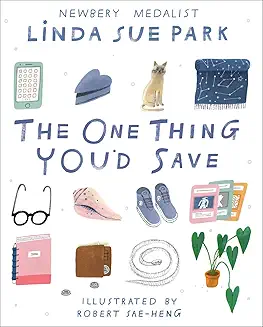
The One Thing You'd Save, written by Linda Sue Park, reviewed by Terry Wahrman
Straight Talk for Librarians: This book makes you evaluate what is important in your life. It would make a great classroom or book club discussion. Loads of pictures and drawings of items on every page make the book approachable for insecure readers. Wonderful teaching tool for students of any age. Written for younger students, but highly recommended for all.
Thursday, September 21, 2023
Dear Treefrog, written by Joyce Sidman, illustrated by Diana Sldyka, reviewed by Klaudia Janek
“I see you
Suddenly
Among the tangled green
A tiny dollop of
Frog”
On the bottom right of the pages, there is factual information about frogs. It reads “Small and agile, gray treefrogs spend most of their lives on land, quietly blending into their surroundings.” Young readers will follow the main character through the seasons and how both lives are changing. The main character will go to her new school and make new friends. She then brings her friends to see the tree frog which goes from being outside to hibernating to being back outside in the spring.
Straight Talk for Librarians: This book is beautifully illustrated with watercolors that both tell a story and show facts, like how frog eggs look, with labels. This would be a great book to use for teaching poetry. It could be used again to show how it also gives non-fiction scientific facts about treefrog lives and habitats. The illustrations have a touch of folk art to them. The colors also match the seasons that are happening in the book. I think the book is unique in style. Both the words and the colors will grab a young reader's attention. They will end up learning a lot of tree frog facts, but also be able to talk about the emotions and experiences that the little girl when through during her move. A must-have book for any elementary school library.
Tuesday, May 30, 2023
The Circus Rose, written by Betsy Cornwell, reviewed by Bethany Bratney
Land of the Cranes, written by Aida Salazar, reviewed by Katy Golden
Tuesday, January 21, 2020
Bull, written by David Elliott, reviewed by Caroline Rabideau
Straight Talk for Librarians: I was captivated by this book, from the minute I saw the cover to the very end of the authors notes. I am so blown away at the skill and craft hidden between the pages. For each character in the book, Elliot uses a different type of poem that he felt best fit that character’s personality. His use of alliteration, coupled with words or phrases our students use every day was both fascinating and edgy. The book read at a quick pace, and was gripping from start to finish. Elliot combined just enough crude language and imagery, plus a dose of sexual jokes and innuendos, to give the reader a taboo feeling, like maybe they were too close to these characters, maybe it bordered on too much information. And yet, his writing, style, and language make the story very real, very down to earth and approachable. I think, for any high school teacher who works with Greek literature in their classroom, this would be a great tool! It would be a great opening story to start discussing Greek lit, and would succeed at getting students attention and making them interested to read more. Further, the whole time I was reading this, I wanted to be back in my AP lit class with Mrs. P. She would have made us act this out, and it would have been great. Though Elliot adds passion and emotion to the characters, I often found myself wondering what tone I should be saying sections in. Should I sound angry, jealous, or sympathetic. This would be a great way to begin this conversation with young theatre students. How would they interpret the characters words? How would they add action to the story? Done on a simple stage like a theatre in the round, I think passionate actors could make such an impact using the spirit Elliot has embodied in his characters. Finally, to talk about poetry. Elliot uses less common poetry structures, like ottava rima, and Italian form of poetry, or cywdd, a Welsh form, to lend personality to his characters. This would be a great introduction to discussing forms of poetry, and using structure in student writing to further emphasize the purpose of the work. I will warn teachers, this book is not for the faint of heart. It has many sexual innuendos, and many straight forward details, which even trounce the number of swear words also woven into the text. Though I did think the sexual content might have slightly overpowered the story, I found that it read with the same wit that I find from Shakespeare, just more modernized and much more raw. I often found myself laughing at the situation as if it were comical. There were a number of swear words, but I was so focused on the text, I found they faded away, mixed in with words like “word,” “whatevs,” “pie hole” and “lol.” Then, in true teacher style, Elliot mixes the common slang with words like “odious,” “consonance,” and “asphyxiating,” giving enough detail to understand the meaning of the word, while also giving the book the high-quality, classic feel of a work of art. I would recommend this book to Mrs. P, my high school English teacher, who was fearless in her pursuit of making us love literature. She often gave us scandalous or emotionally-changed works to read, knowing her audience, knowing what caught our attention. This book will captivate your students and could be read completely in one to two class periods. It is slightly uncomfortable and unnerving to read, but I feel there is intention behind that. I’d say, if you’re comfortable with the topics included, go for it.
Check out David Elliott's Pinterest companion page for this book. Click here.
Wednesday, January 15, 2020
The Crossover (Graphic Novel), written by Kwame Alexander, illustrated by Dawud Anyabwile, reviewed by Amanda Davies
Straight Talk for Librarians: Alexander's outstanding, visual poetry is brought more vividly to life by Anyabwile's illustrations. Anyabwile restricts his color palette to orange, black, and white, continuing the colors first used on Alexander's novel. The orange brings to mind the color of a basketball and is used largely as background color other than when it's being used for the ball itself. Anyabwile uses a combination of framed and unframed illustrations to help direct the reader's focus. Students who loved the novel will love this graphic version of it. English teachers could easily use the book as a mentor text for student writing, either in its entirety or as individual poems. In addition to having students model their own writing after Alexander's, Anyabwile's illustrations provide inspiration for illustrating text or as mentors for projects in art class. There is so much to unpack throughout both the text and illustrations when it comes to allusion, theme, onomatopoeia, word choice, voice, color palette, and inference.
Tuesday, December 3, 2019
The Crossover (Spanish), written by Kwame Alexander, reviewed by Amanda Davies
Straight Talk for Librarians: The Spanish language version of The Crossover is a great addition to any school library both for students whose first language is English and for students who are learning Spanish. In addition to the benefit of providing a book in a student's first language for the pure pleasure of it, English learners could use the English version to compare the use of vocabulary and word choice. Similarly, students learning Spanish or Spanish language teachers could use the book to look for the ways that language is manipulated similarly and differently in each language. Because the book is written in poetry and many of the poems can stand on their own, Spanish teachers or English Language teachers could use a poem or two in a lesson to enable students to identify similarities and differences. In addition to its value as a powerful story, the Spanish language version of the Crossover provides many opportunities for curricular connections.
Monday, October 21, 2019
The Ugly Five, written by Julia Donaldson, reviewed by Klaudia Janek
Summary: “We’re the ugly five, we’re the ugly five.” After the introduction of some more well-known beasts of the savannah, the first of the ugly five steps in--a wildebeest who boasts about her ugly qualities, loving her position as the “ugliest.” Then, she stumbles into a hyena, who describes their own qualities one by one, taking pride in their position as ugliest. The two pair up, ambling along to meet the others, singing about their ugliness and collecting the other animals one by one--the vulture, then the warthog, and finally marabou stork--flaunting the same pride and combining forces. Still, they mention qualities that others may find painful or unlikeable. After collecting all five, the five beasts stumble into a surprise: infantile versions of the ugly five! “We’re your babies.” They appreciate their actions, showering the Ugly Five in love and compliments, turning their title around to “the Lovely Five.”
Straight Talk for Librarians: The book is a cheerful, endearing work on being happy with yourself, making a community, family, and love past appearances. The author writes in rhymes and repetition in order to create a flowing rhythm, which appeals to a reader. The formatting also develops a pattern to look forward to, keeping the book positive. The animals’ loudness and energy when talking about their ugly qualities also maintains the cheerful energy in the book. In addition, the illustrations paired with each section maintains mainly bright colors but keeping to the warmer, earthy tones. The animals also all smile when they unify, demonstrating the positivity in the community. It can be used as a funny, charming story of self-love and found family.